How to Build a Complete Content Strategy From Your Conference Recordings
Your conference recordings contain everything you need for a year-round content strategy
Your conference recordings contain everything you need for a year-round content strategy — blog posts, social campaigns, video clips, sponsor reports, member resources, and marketing assets. The key is processing recordings through an AI platform that generates all of these automatically, then distributing on a calendar that extends your event's value for months. Here's the framework.
Why Should You Build Content From Conference Recordings?
Most event organizations treat content as a byproduct. The conference happens, recordings get saved, and maybe someone clips a keynote highlight for social media. The remaining 95% of content value goes unused.
The organizations that treat recordings as a content asset — not a byproduct — are generating 10–25% additional revenue and seeing 63% of attendees return to engage with content up to 6 months post-event. The difference isn't having better recordings. It's having a system to turn them into content.
That system used to require a team of contractors working for weeks. With AI, it takes hours.
Step 1 — Audit What You Have
Start by listing every session you recorded. For each session, note the speaker, company, topic, and format (keynote, panel, workshop, fireside). This is your content inventory.
Sessions with evergreen topics (regulatory compliance, industry frameworks, leadership strategies) have the longest monetization window. Sessions covering breaking news or time-sensitive topics should be prioritized for quick-turn content.
If you have recordings from previous years, include those. A 5-year archive of conference content is a knowledge library — not a storage problem.
Step 2 — Process Everything Through AI
This is where manual content strategies fail. Processing 50 sessions manually is a months-long project. Conference AI processes them in hours.
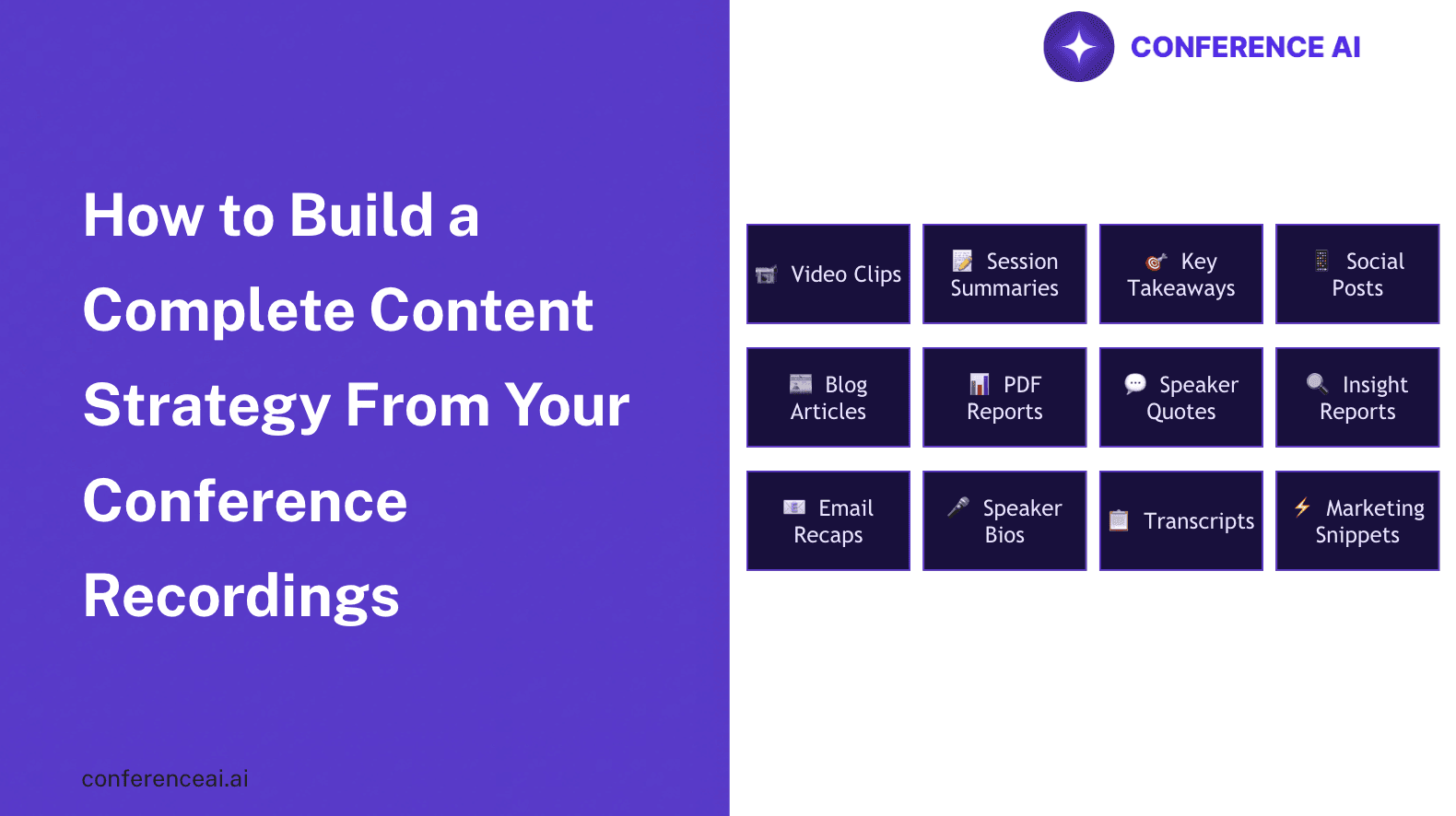
Upload your recordings, connect your agenda data, and the AI generates 20+ content types per session: transcripts, summaries, blog posts, video clips, social media posts, executive summaries, sponsor reports, quote cards, cross-session trend analysis, and more. Every output is formatted in your brand voice.
The important shift: your team stops doing production work and starts doing strategy work. Instead of "who's going to transcribe this session?" the question becomes "how do we distribute this content for maximum impact?"
Step 3 — Build a 90-Day Content Calendar
Timeline | Content Focus | Channel |
|---|---|---|
Week 1 | Highlight clips, keynote quotes, "in case you missed it" | Social media, email |
Weeks 2-3 | Session blog posts, speaker quote cards | Blog, LinkedIn, newsletter |
Weeks 4-6 | Topic-based compilations, track recaps | Member portal, content library |
Weeks 7-9 | Executive summaries, trend reports | email to leadership, sponsors |
Weeks 10-12 | Evergreen content refresh, "most popular sessions" | Blog, social, SEO |
Ongoing | On-demand library, CE credits, archieve access | Member portal, LMS |
Don't release everything at once. A structured distribution calendar extends your event's relevance for months. Conference AI generates all of this content upfront. Your team's job is scheduling distribution, not producing assets.
Step 4 — Monetize the Content
Conference content has direct revenue potential through four models:
Registration add-on. Offer on-demand access at 10–20% of ticket price during checkout. 15%+ revenue increase from the checkbox alone.
Non-attendee access. Email your list 2–4 weeks post-event with on-demand access at 25–50% of ticket price.
Membership subscription. Bundle content from multiple events into annual membership with full archive access.
Premium reports. Sell AI-generated executive summaries as PDF business reports at $500–$1,000+ per event.
Step 5 — Use Content to Sell Next Year's Event
Your best marketing for next year's conference is this year's content. Use session clips and quotes in promotional campaigns. Show potential attendees what they'll experience. Turn your content library into a preview of your event's value.
Organizations with deep content archives report stronger attendee retention because the event never really "ends." Members stay engaged between events, which makes the renewal conversation easier.
What Tools Do You Need?
Conference AI handles content generation and distribution. It processes recordings, generates 20+ content types, provides a searchable content library, and integrates with your event platform via API. Flat-rate pricing: $199/mo (Starter) or $499/mo (Pro, unlimited). No per-session fees.
Your event platform (Swoogo, Cvent, Swapcard) handles registration and the content add-on checkout.
Your social media scheduler handles the distribution calendar. Conference AI exports assets formatted for each platform.
→ See how Conference AI powers your content strategy: conferenceai.ai/bookademo
Key Takeaways
Your recordings are a content library waiting to be activated. The value isn't in the recording itself — it's in the 20+ assets that can be generated from each one.
AI eliminates the production bottleneck. The reason most content strategies fail post-event is production capacity. AI solves that.
Distribution is strategy, not production. When AI handles production, your team focuses on when and where content reaches your audience — the work that actually drives engagement and revenue.
Try It Out
Custom topic tagging and AI-generated tags are live now on all plans. If you're already a customer, you'll see the tagging options on every session page.
If you're not a customer yet — Conference AI automatically turns your event recordings into ready-to-publish content. Transcripts, summaries, video clips, social content, sponsor intelligence, and now fully tagged and searchable content libraries. All from one platform.
Pricing: Starter $199/mo (limited usage). Pro $499/mo (unlimited, flat-rate). No per-session fees.
→ Book a demo: conferenceai.ai/bookademo
→ Learn more: conferenceai.ai