How to Build a Post-Event Content Strategy That Extends Your Conference's Value for Months
A post-event content strategy turns your conference from a 3-day experience into a 12-month content engine.
A post-event content strategy turns your conference from a 3-day experience into a 12-month content engine. The framework: capture everything, process through AI immediately, distribute on a 90-day calendar, monetize through tiered access, and use engagement data to plan next year's event. Organizations doing this well see 63% of attendees returning to consume content up to 6 months after the event ends.
Why Do You Need a Post-Event Content Strategy?
Most events end on the last day of the conference. The badge scanners shut off, the booths come down, and whatever momentum you built dissipates within a week. Your marketing team posts a few photos on LinkedIn, sends a "thank you for attending" email, and moves on to the next event.
The problem isn't effort — it's that there's no system for turning event content into an ongoing asset. The recordings exist. The insights exist. The demand exists (people ask for content constantly). What's missing is a structured approach to production and distribution.
Without a strategy, you get: recordings collecting dust, sponsors who forget about you between events, attendees who disengage until next year's registration opens, and leadership asking "what was the ROI on that conference?"
With a strategy, you get: continuous member engagement, new revenue from content sales, data that proves event ROI, and sponsors who stay engaged year-round.
The 5-Phase Post-Event Content Framework
Phase 1: Capture Everything (Pre-Event)
Your content strategy starts before the event, not after.
Lock down speaker rights. Your speaker agreements should include language granting rights to record, edit, distribute, and sell content from their sessions. This is non-negotiable — without it, your entire post-event content strategy has a legal vulnerability.
Plan for quality capture. Budget for professional A/V or connect an AI platform like Conference AI via RTMP for real-time ingestion. Poor audio kills content quality regardless of how good your AI processing is.
Pre-build your content packages. Decide before the event what content products you'll sell: registration add-ons, non-attendee access, premium reports, membership bundles. Build these into your registration flow.
Phase 2: Process Immediately (Event Week)
Speed matters. Content loses relevance quickly. The ideal timeline is content ready for review within 24–48 hours of each session.
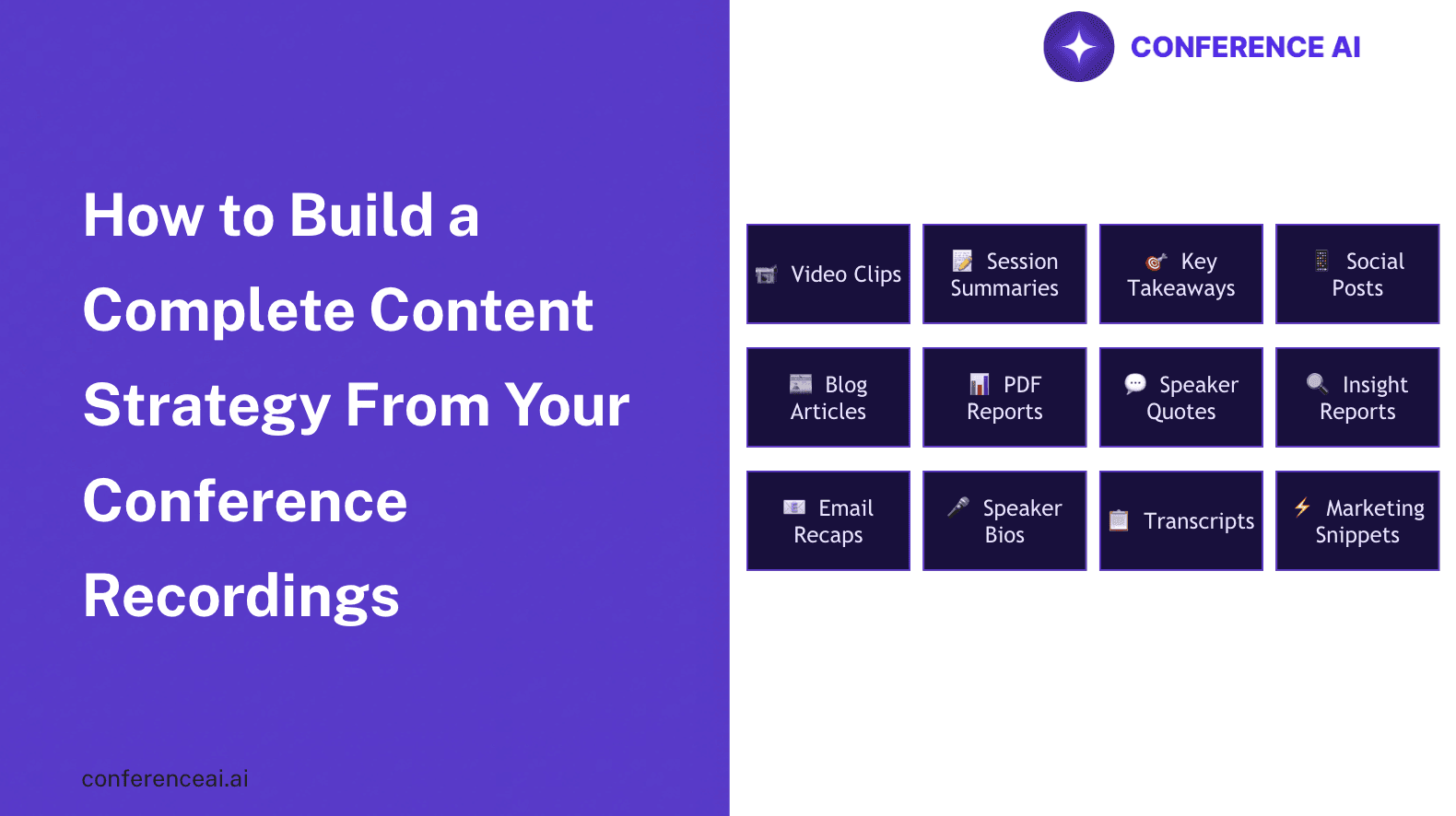
Conference AI processes recordings and generates 20+ content types per session — transcripts, summaries, blog posts, video clips, social posts, executive summaries, sponsor reports, quote cards, and cross-session analysis. Processing happens in hours, not weeks.
Your team reviews and approves output rather than producing it. This is the key operational shift — from "we need to create content" to "we need to review and distribute content."
Phase 3: Distribute on a Calendar (Weeks 1–12)
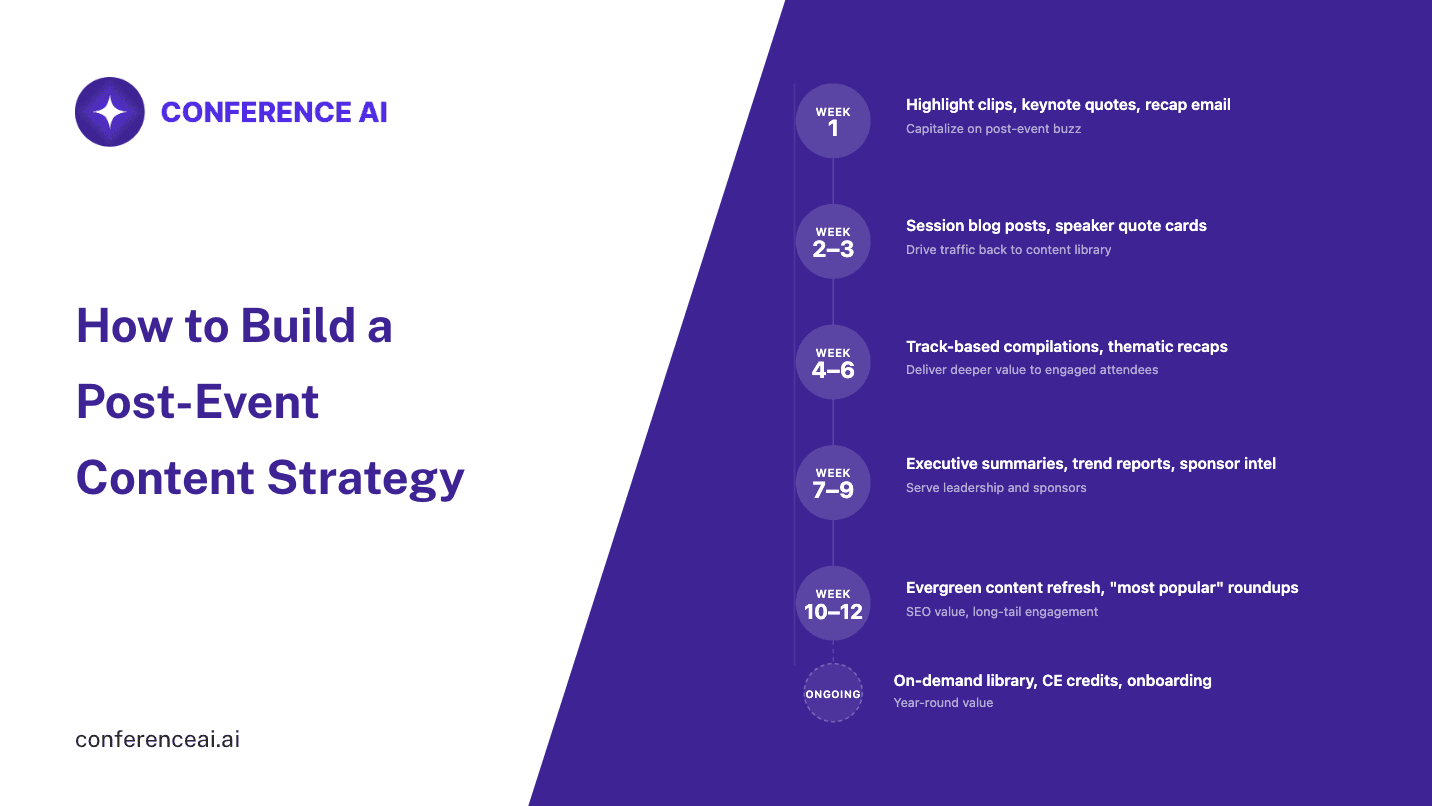
Week | Content Type | Goal |
|---|---|---|
1 | Highlight clips, keynote quotes, recap email | Capitalize on post-event buzz |
2–3 | Session blog posts, speaker quote cards | Drive traffic back to content library |
4–6 | Track-based compilations, thematic recaps | Deliver deeper value to engaged attendees |
7–9 | Executive summaries, trend reports, sponsor intelligence | Serve leadership and sponsors |
10–12 | Evergreen content refresh, "most popular" roundups | SEO value, long-tail engagement |
Ongoing | On-demand library, CE credits, new member onboarding | Year-round value |
Don't dump everything at once. A structured release calendar extends your event's relevance.
Phase 4: Monetize the Content (Ongoing)
Four revenue models to layer in:
Registration add-on at 10–20% of ticket price. Easiest to implement — add a checkbox to your registration form.
Non-attendee access at 25–50% of ticket price, marketed 2–4 weeks post-event to your broader list.
Membership subscription bundling content from multiple events into annual access.
Premium reports — AI-generated executive summaries sold as PDF business reports at $500–$1,000+ per event.
Phase 5: Learn and Plan (Month 3+)
Use engagement data to inform next year's event.
Which sessions had the most post-event views? Those topics should be expanded next year. Which content formats drove the most engagement — blog posts, clips, or reports? Double down on what works. Which sponsors benefited most from post-event content exposure? Use that data in renewal conversations.
Conference AI tracks login data, playback analytics, engagement over time, and content consumption patterns — the metrics your leadership team needs for ROI reporting.
What Tools Power This Strategy? | ||
Layer | Tool | Role |
|---|---|---|
Content production | Conference AI | Generates all post-event content from recordings |
Distribution | Your event app + social scheduler | Pushes content to attendees and public |
Monetization | Your registration platform | Handles payment for content add-ons |
Analytics | Conference AI | Tracks engagement, proves ROI |
Conference AI handles the production and analytics layers. Your existing event platform and social tools handle distribution and monetization. No new tools for your team to learn.
Key Takeaways
Start before the event. Speaker rights, capture quality, and content packages need to be in place before the first session.
Speed wins. Content ready within 48 hours captures post-event momentum. Content ready in 6 weeks misses it.
Distribution is a calendar, not a dump. Structured release over 12 weeks extends relevance and maximizes engagement.
Try It Out
Custom topic tagging and AI-generated tags are live now on all plans. If you're already a customer, you'll see the tagging options on every session page.
If you're not a customer yet — Conference AI automatically turns your event recordings into ready-to-publish content. Transcripts, summaries, video clips, social content, sponsor intelligence, and now fully tagged and searchable content libraries. All from one platform.
Pricing: Starter $199/mo (limited usage). Pro $499/mo (unlimited, flat-rate). No per-session fees.
→ Book a demo: conferenceai.ai/bookademo
→ Learn more: conferenceai.ai