Best Practices for Post-Event Monetization: What Works (And What Doesn’t)
Post-event content monetization sounds promising in theory 👀
Post-event content monetization sounds promising in theory: turn your conference sessions into recurring revenue, engage attendees year-round, and maximize the value of content you’re already creating. But between concept and execution lies a minefield of potential mistakes that can turn a promising strategy into an expensive failure.
After analyzing dozens of events that monetize post-event content, from massive trade shows to niche conferences, clear patterns emerge about what works and what doesn’t. Here are the battle-tested best practices that separate successful implementations from expensive failures.
Best Practice 1: Plan for Post-Event Monetization from Day One
What works: Treating content monetization as a core event objective from the earliest planning stages. This means:
· Budgeting for quality recording: Allocating funds for professional A/V capture or AI recording platforms ensures content is usable for commercial purposes. Poor audio or video quality kills monetization potential.
· Securing speaker rights upfront: Including clear language in speaker agreements that grants you rights to record, edit, and sell their content. Negotiating after the fact is difficult and sometimes impossible.
· Building monetization into registration: Offering on-demand content packages during ticket sales, not as an afterthought. This captures buyers when they’re already in purchase mode.
· Designing content for reuse: Choosing session formats and topics that have evergreen value and can be sold long after the event. Highly topical content has shorter monetization windows.
Implementation tip: Create a “content monetization checklist” that runs parallel to your standard event planning checklist. Each milestone, such as speaker confirmations, venue booking, and marketing launch, should have corresponding content monetization tasks.
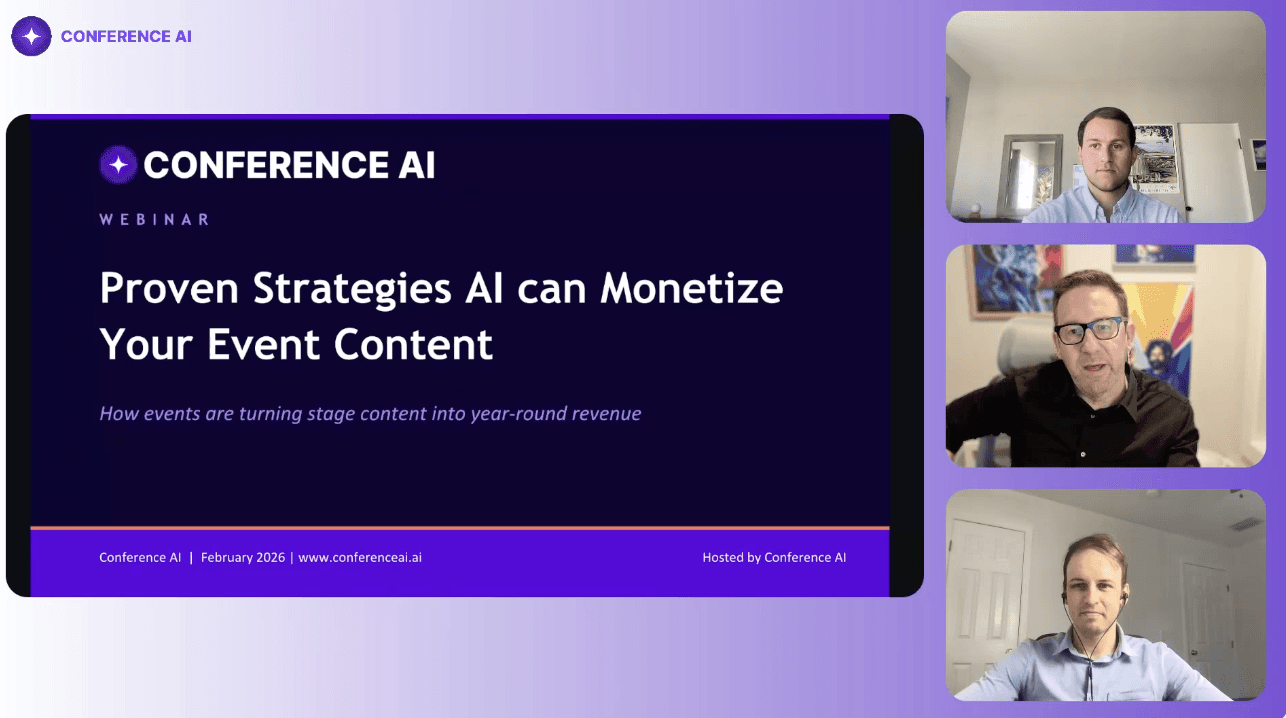
Want to dive more into this practice? Watch our latest webinar here, featuring Mark Johnson, former executive at Swoogo alongside Conference AI 👇
Best Practice 2: Protect Live Event Value While Monetizing Content
What works: The concern is legitimate: If you give away or sell all content immediately, will people still pay to attend in person? The key is strategic differentiation:
· Emphasize live-only benefits: Networking, real-time Q&A, hands-on workshops, serendipitous connections, and being part of the energy. Make clear that content is just one component of value.
· Create exclusivity tiers: Attendees get free or discounted content access as a perk; non-attendees pay premium prices; and VIP ticket holders get bonus content not available to others.
· Timing strategies: Release content to attendees immediately, but delay public sales for 2-4 weeks. This rewards attendance while still capturing non-attendee revenue when momentum remains.
· Selective content release: Make 20-30% of content free (usually keynotes) while keeping the majority behind paywalls. This demonstrates value without cannibalizing attendance.
What doesn’t work: Releasing everything free immediately demoralizes attendees and makes future sales harder, while keeping all content locked away helps no one.
Implementation tip: Survey attendees about their expectations. Would they feel valued if content came free with their ticket? Would they pay extra for enhanced content packages? Use data to inform your strategy rather than guessing.
Best Practice 3: Price Strategically for Your Market
What works: Pricing that reflects both your audience’s willingness to pay and your content’s uniqueness:
· Test and refine: Start with pilot pricing, gather feedback, and adjust. One conference found $29 had 70% uptake, while $99 had only 15% but $99 generated more total revenue with less customer service burden.
· Anchor pricing with bundles: Offer a comprehensive package at your target price, then create smaller packages below it. Psychology works: when people see a $499 full package, a $199 partial package feels more reasonable.
· Segment by audience: Attendees get loyalty pricing ($49), non-attendees pay market rates ($299), and corporate buyers pay volume rates ($2,500 for 20 employees). Different audiences have different valuations.
· Value-based pricing: Don’t price based on your costs (recording + platform fees); price based on value delivered. If your content helps someone generate $50K in new business or save 40 hours of research time, $499 is trivial.
What doesn’t work: Underpricing because you’re uncomfortable charging for content, or overpricing without differentiation. For example, if your conference costs $1,500 to attend live, on-demand access shouldn’t be $19—that signals the content isn’t valuable. On the flipside, if similar industry content is available free on YouTube, your $999 package had better include substantial unique value, such as AI-generated summaries, exclusive interviews, and certification credits.
Implementation tip: Create pricing tiers with clear value differentiation. A basic package at $X, premium at $2-3X with added benefits, and deluxe at $5-7X for comprehensive access plus extras. Tiered structure alone often increases revenue by encouraging “middle option” purchases.
Best Practice 4: Market Post-Event Content Aggressively
What works: Treating content sales like product launches with dedicated campaigns:
· Multi-channel promotion: Email sequences (3-5 messages over 2-3 weeks), social media (daily posts for first week, then 3x/week), website banners, retargeting ads, partner promotion.
· Social proof via attendee testimonials and speaker amplification: Share clips of powerful moments with captions like “This insight changed how I approach X” or “Worth the price of admission alone.” Ask speakers to share that their content is now available on-demand. Their audiences then become your potential customers.
· Create urgency with limited-time pricing or early-bird discounts that expire, or limited availability for certain packages.
What doesn’t work: Sending one email announcement then forgetting about it, assuming people will discover your content on their own, or being shy about promoting because you don’t want to seem “salesy.” Remember, you’re selling valuable knowledge, not snake oil.
Implementation tip: Build a 90-day content promotion calendar. Example: Week 1-2: Launch buzz; Week 3-4: Social proof and testimonials; Week 5-8: Themed content highlighting specific tracks or topics; Week 9-12: Last chance messaging. Keep content visible long-term, not just immediately post-event.
Best Practice 5: Deliver Exceptional Customer Experience
What works: Making content consumption seamless and valuable:
· Professional platforms: User-friendly interfaces that work flawlessly on mobile and desktop; fast streaming with adaptive quality; clean, intuitive navigation; search and filter functionality.
· Complete packages: If you promise “session recordings,” include slides and transcripts, too. Under-promise and over-deliver.
· Responsive support: Quick answers to technical issues or access problems. Nothing damages a reputation like taking someone’s money and being unreachable when they have problems.
· Bonus value: Surprise buyers with extras, such as an exclusive interview with a keynote speaker, or early access to next year’s registration. Small touches generate loyalty.
Implementation tip: Soft-launch to a small test group (your planning committee or advisory board) before public release, and let them find bugs and usability issues. A day of testing prevents weeks of customer complaints.
Best Practice 6: Use Data to Continuously Improve
What works: Treating post-event monetization as an iterative process:
· Track everything: Conversion rates at each price point, which content packages sell best, where customers drop off in the purchase flow, and which marketing channels drive sales.
· Collect feedback: Survey buyers about their experience. What did they find most valuable? What was missing? Would they buy again? Net Promoter Score is a useful metric.
· Analyze content performance: Which sessions get viewed most? Where do people stop watching? Which generate the most sharing or discussion? This informs future event programming and content packaging.
· A/B testing: Test different price points, package compositions, and marketing messages with small segments before rolling out broadly.
What doesn’t work: Running the same strategy year after year without analyzing results or ignoring low conversion rates.
Implementation tip: Create a post-mortem report 60 days after launching content sales. Document what worked, what didn’t, revenue vs. projections, and lessons learned. Make this mandatory reading for next year’s planning team.
Best Practice 7: Leverage AI to Scale Without Losing Quality
What works: Using artificial intelligence to handle repetitive work while humans focus on strategy and quality control:
· Automated transcription and summarization: AI generates first drafts in minutes instead of humans taking days. Human editors review and refine for accuracy and tone.
· Bulk content generation: AI creates dozens of social media clips, highlight reels, and quote graphics from each session. Humans curate the best ones for distribution.
· Data analysis at scale: AI processes engagement data across 50-100 sessions to identify trends and intent signals impossible to spot manually.
· Personalized recommendations: AI suggests relevant content to specific attendees based on their interests and behavior, improving engagement and sales.
What doesn’t work: Using AI as an excuse for mediocrity (“the AI generated it, so that’s what we’re going with”), and skipping human review of AI-generated content, which could include errors or miss nuance. Going entirely manual when AI could save 80% of the work either limits your output or consumes unsustainable resources.
Implementation tip: Adopt an “AI for automation, humans for creativity” model. Let AI handle transcription, initial editing, and data processing, while humans add strategic thinking, quality control, and creative packaging.
Best Practice 8: Start Simple and Scale
What works: Beginning with one or two monetization strategies, perfecting them, and then adding more:
· Year 1: Offer basic on-demand content packages to attendees and non-attendees. Master the logistics of content delivery and payment processing.
· Year 2: Add premium content bundles (executive summaries, thematic compilations) and basic sponsor engagement reports.
· Year 3: Implement subscription models, content marketplace, and advanced sponsor intelligence products.
This staged approach lets you learn, build capabilities, and demonstrate value before scaling investment.
What doesn’t work: Attempting to launch all seven monetization strategies simultaneously and overwhelming your team and technology with complexity. Spreading resources too thin across multiple initiatives means none get executed well.
Implementation tip: Choose the 1-2 strategies best aligned with your audience and event type. A B2B technology conference might prioritize sponsor intelligence, while a consumer wellness expo might focus on content subscriptions. Play to your strengths.
The Implementation Roadmap
Putting this all together, here’s a practical 12-month roadmap:
Months 1-3 (Planning):
· Secure budget and leadership buy-in
· Choose AI platform partner for content capture
· Update speaker agreements with content rights language
· Design initial monetization strategy (1-2 approaches)
Months 4-6 (Pre-Event):
· Build content packages into registration
· Brief speakers on content capture plans
· Set up recording infrastructure and platforms
· Create marketing plan for post-event sales
Months 7-8 (Event & Immediate Post):
· Execute flawless content capture
· Process content through AI (transcription, summarization, editing)
· Quality check all content for accuracy before release
· Launch content sales within 3-7 days post-event
Months 9-10 (Active Sales):
· Execute marketing campaign
· Respond to customer issues quickly
· Track performance metrics
· Refine your approach based on early results
Months 11-12 (Analysis & Planning):
· Comprehensive post-mortem analysis
· Calculate ROI and lessons learned
· Plan year 2 enhancements
· Begin next event cycle with improvements
The Reality Check
According to our research, organizations implementing even basic post-event content monetization typically generate 10-25% additional revenue while building deeper relationships with attendees and sponsors. But those who use AI to scale these efforts can see even higher returns with lower operational costs.
The events industry is shifting from transactional (sell a ticket, deliver an experience, move on) to relational (deliver ongoing value, maintain year-round engagement, build community). Post-event content monetization is how you make that shift financially sustainable.
Your Next Steps
You now have the strategies, the technology overview, and the implementation best practices, but what’s missing is the detailed how-to guide that walks through every step with templates, pricing worksheets, and real case studies.
That’s exactly what our complete white paper provides: a comprehensive blueprint for transforming your events into year-round revenue engines through post-event content monetization.
Download “The Event Ends, But the Revenue Doesn’t” white paper here.
The opportunity is waiting. Will you capture it?