How AI is Transforming Post-Event Content Creation
How AI is Transforming Post-Event Content Creation
How AI is Transforming Post-Event Content Creation (And Why You Need It)
In our previous discussions, we’ve explored the post-event monetization landscape and emerging AI capabilities. Now let's examine how these technologies work in practice.
Picture this: Your two-day conference just wrapped. You recorded 50 sessions totaling 60 hours of content. Now what?
In the traditional model, you’d face weeks or months of manual work: transcribing sessions, editing videos, writing summaries, identifying key insights, and creating promotional clips. By the time your content is ready, momentum has faded and opportunities have been missed.
This is the post-event content bottleneck that has plagued organizers for years. It’s why so many valuable insights evaporate instead of becoming revenue-generating assets.
Enter artificial intelligence, and a fundamental transformation in how events capture, process, and monetize content.
The Manual Content Creation Bottleneck
Let’s quantify the traditional challenge:
Transcription: Manually transcribing one hour of audio takes approximately 4-6 hours for a professional transcriptionist. Your 60 hours of conference content would require 240-360 hours of transcription work at $25-$50 per hour—that's $6,000-$18,000 in costs alone.
Video editing: Creating highlight reels, promotional clips, and polished session recordings requires skilled editors charging approximately $50-$150 per hour. Even basic editing of your 50 sessions could consume 100+ hours and $5,000-$15,000.
Summary writing: Producing executive summaries or session takeaways requires someone to watch each session and distill key points. At 15-20 minutes per session summary, you’re looking at another 12-16 hours of work.
Data analysis: Identifying trending topics, engagement patterns, and sponsor insights from attendee behavior requires manual review of chat logs, Q&A transcripts, and analytics—potentially dozens more hours.
Total cost and time: You’re easily looking at $15,000-$40,000 and 4-8 weeks of production time. For many event teams, this is simply prohibitive. The content sits unused, revenue opportunities vanish, and the cycle repeats.
Even if you have the budget, the timeline is the killer. By the time content is ready 6-8 weeks post-event, attendee engagement has dropped significantly and the window for selling on-demand access has largely closed.
How AI Solves the Problem: Automation at Scale
Modern AI solutions designed for event content change the equation entirely:
· Transcribe hours of audio with 95%+ accuracy in minutes, not days
· Automatically identify and extract highlight moments from video
· Generate summaries, key takeaways, and executive briefings from transcripts
· Create short-form social media clips optimized for different platforms
· Analyze content to surface trending topics, frequently asked questions, and sentiment
· Map engagement data to specific attendees and companies to reveal intent signals
The result? What once took weeks and cost tens of thousands can now be accomplished in hours or days for a fraction of the cost.
Content AI: Automated Post-Event Content Creation
Content AI represents the first pillar of AI-powered event content management. It focuses on generating the tangible content outputs, such as videos, summaries, reports, that organizers can package and monetize.
The platform records and transcribes every session in real-time, producing complete, searchable transcripts the moment a speaker finishes. It then analyzes those transcripts to identify key insights, memorable quotes, and actionable takeaways, generating executive summaries of different lengths formatted for different audiences.
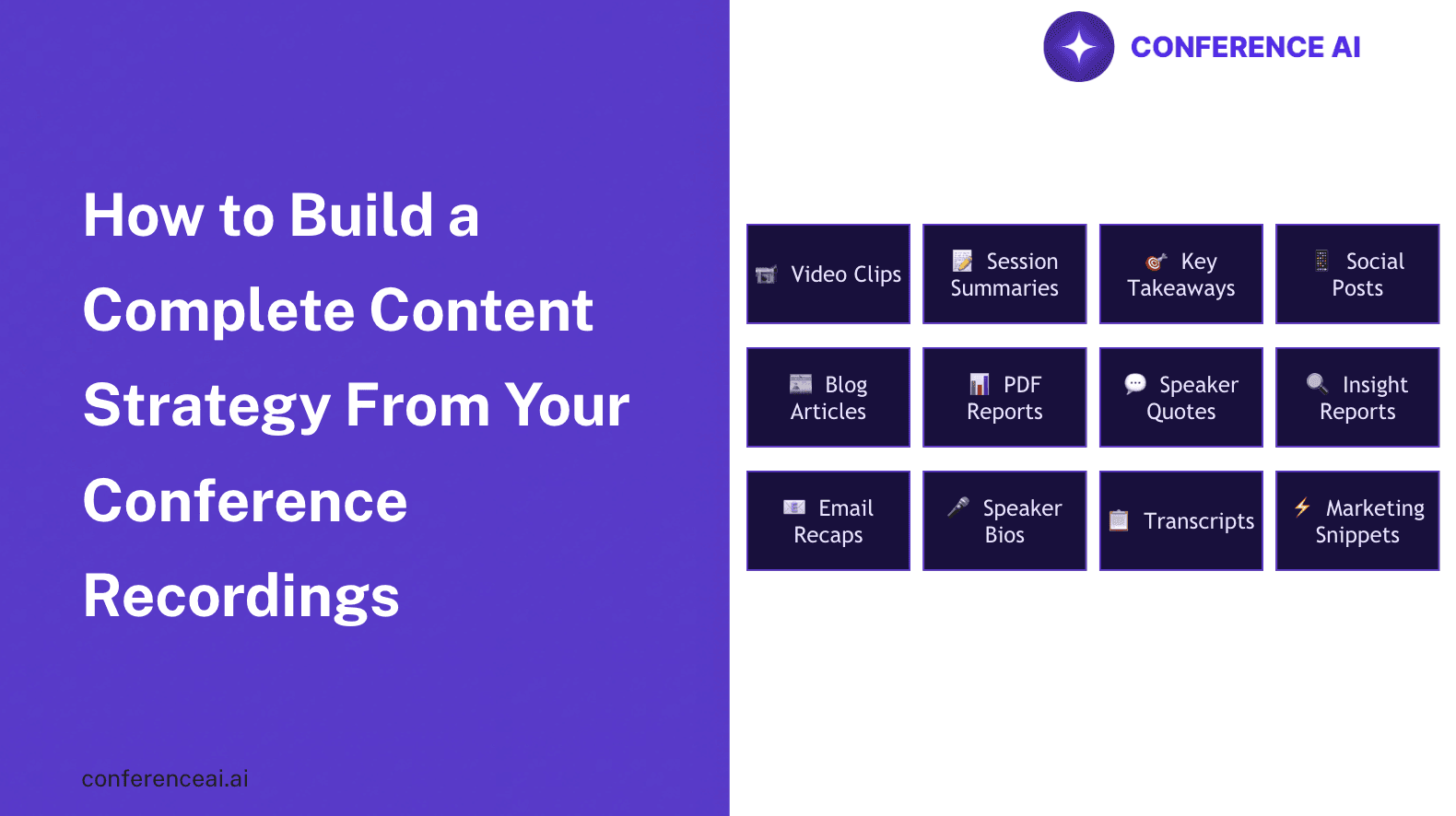
From a single session, Content AI can automatically create dozens of assets: polished full recordings, 10-15 short highlight clips for social media, quote cards with speaker images, and topic-specific compilation videos. Need a podcast version? Audio-only files with chapters. Want blog content? Article drafts based on session content. This happens automatically based on AI analysis of what moments are most compelling or informative.
For organizers, this is transformational. As soon as your event ends, you have a library of ready-to-use, revenue-ready content. You can immediately start selling on-demand access, promoting highlights on social media, and delivering premium content packages.
One event technology provider described the impact: “So much valuable content happens on stage, but it’s hard to repurpose effectively. We’re exploring how to turn sessions into highlights and deeper takeaways that extend their impact.” With Content AI, that exploration becomes reality, automatically.
Stage Intelligence AI: Turning Conversations Into Data Gold
The second pillar, Stage Intelligence AI, takes a different approach. Rather than just creating content assets, it analyzes what was discussed on stage and maps it to who and what it’s relevant to, uncovering actionable business intelligence.
Stage Intelligence processes all your event’s conversations to identify patterns and themes that would be impossible to spot manually: which subjects came up most frequently, what pain points speakers and attendees repeatedly mentioned, and which emerging trends dominated discussions. It measures actual intellectual engagement, such as which sessions generated the most questions, what topics sparked debate, and which speakers resonated most strongly.
Here’s where it gets powerful for monetization: Stage Intelligence can identify when someone from Company X attended multiple sessions about cybersecurity, asked questions about cloud threat prevention, and downloaded related resources. That’s a clear buying intent signal. The AI maps these behaviors to specific individuals and companies, creating a database of actionable leads. It also captures competitive intelligence, including what attendees said about competitors, what alternative solutions were discussed, and what objections came up repeatedly.
For organizers, Stage Intelligence transforms your event from a collection of isolated sessions into a structured database of industry insights, market intelligence, and qualified leads. This becomes the foundation for premium sponsor data products that can command approximately $5,000-$25,000 per sponsor.
As Conference AI explains: “Stage Intelligence maps every conversation on stage to the people and companies behind it—revealing intent, challenges, and buying signals you can use to drive real business outcomes.”
Real-World Impact: The Informa Partnership
The proof is in adoption by industry leaders. Informa PLC, one of the world’s largest event companies that produces more than 500 events annually, recently established a master agreement with Conference AI to deploy these AI solutions across its global portfolio.
Their goal? Transform live events into year-round revenue engines through AI-powered content and insights.
Their pilot at SupplySide Global demonstrated the potential. With Conference AI’s platform, Informa could immediately capture and structure all session content for on-demand sales, generate marketing assets for promoting post-event packages, provide sponsors with detailed engagement and intent data, create executive summaries for non-attendee sales, and build a content library for year-round access.
All of this happened automatically, with minimal manual intervention, and the show’s organizers reported that the ease of implementation and rapid content availability dramatically changed their post-event monetization capabilities.
The ROI Equation: Less Cost, Faster Revenue, Greater Scale
Let’s return to our 50-session conference example and compare the traditional vs. AI-powered approach:
Traditional approach:
· Cost: $15,000-$40,000
· Timeline: 6-8 weeks
· Output: Basic transcripts, edited videos, manual summaries
· Revenue window: Limited (momentum lost)
AI-powered approach:
· Cost: $3,000-$8,000 (platform subscription)
· Timeline: 2-5 days
· Output: Transcripts, summaries, highlight clips, social media assets, intent reports, executive briefings—all automated
· Revenue window: Maximum (content available immediately)
The difference is stark. You’re cutting costs by 50-80% while accelerating time-to-market by 90%. More importantly, you’re producing 10-20x more content assets because AI doesn’t face the time constraints that humans do.
This improved ROI manifests in multiple ways: Start selling on-demand access within days when attendee interest is still high. AI-edited videos and professionally formatted reports command premium prices. Produce enough content assets to support multiple revenue streams—on-demand sales, premium packages, sponsor reports, marketplace listings—simultaneously. Whether you have 10 sessions or 200, AI handles the workload equally well, so your content monetization strategy scales with your event growth without proportionally scaling costs.
Why You Need AI Now
Three converging forces make AI adoption worth serious consideration:
Market expectations: The 79% of organizers who see increased monetization opportunities in digital content? They’re your competitors. Attendees and sponsors increasingly expect post-event content and data as standard offerings. Without AI, you can’t meet these expectations cost-effectively.
Revenue imperative: As in-person event costs rise, diversifying revenue streams becomes critical. Post-event content monetization can represent 15-30% of total event revenue, but only if you can produce content efficiently enough to make it profitable.
Technology maturity: Early AI tools were clunky and unreliable, but today’s solutions are event-specific, accurate, and user-friendly. Conference AI emphasizes ease of use: “Getting started is as simple as uploading your content…that’s it. No complex setup or training required.” The technology has reached a point where implementation barriers have largely disappeared.
The Future Is Automated
Post-event content monetization without AI is becoming increasingly challenging in a competitive landscape. The technology doesn’t eliminate the need for human strategy, creativity, and quality control, but it eliminates the manual grunt work that has historically made post-event monetization prohibitively expensive and slow.
For many organizers, the question is shifting from whether to adopt AI to how quickly they can implement it effectively, and which solutions best fit their specific needs.
Discover how Conference AI’s Content AI and Stage Intelligence can transform your event's post-event monetization. Download our complete white paper here for detailed implementation guidance and ROI calculators.